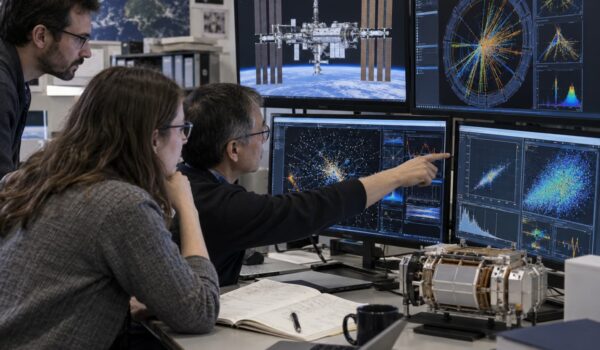
Space experiments are often imagined as machines that collect data, publish their main results and eventually become scientifically outdated. In reality, the information gathered by a major mission can remain useful for many years. A particle detected a decade ago does not change, but the way scientists interpret its signal can improve dramatically. Better calibration, more powerful computers, new reconstruction methods and entirely new scientific questions can turn an old dataset into a source of fresh discoveries. This is especially important in particle physics and cosmic-ray research, where experiments such as AMS-02 record enormous numbers of events over long periods.
Each event contains information from several detector systems: particle trajectories, charge, energy, timing and other measurements. When the data is first collected, scientists analyse it using the best calibration and software available at the time. Years later, however, the same events can be processed again with a much deeper understanding of how the detector behaved. Temperatures may have changed during the mission, electronic channels may have aged differently and individual sensors may have slowly shifted in response. As these effects become better understood, scientists can refine the corrections applied to old measurements and reconstruct particle properties more accurately.
A small improvement in calibration can matter greatly when billions of events are involved. A slight change in the estimated energy of a particle, for example, may alter the shape of an energy spectrum or reduce uncertainty in a region where researchers are looking for an unusual feature. The observations themselves have not changed. What changes is the ability to interpret them. This is one reason a dataset may become more valuable with time rather than less valuable: later analyses can benefit from years of accumulated knowledge about the instrument.
Improved reconstruction software can produce similar gains. A detector rarely observes a particle in a single, simple way. Instead, the particle passes through several layers and leaves different kinds of signals. Software must combine those signals to estimate what the particle was and how it moved through the instrument. Early reconstruction algorithms may already work well, but later versions can use more detailed detector models, improved mathematical techniques and better treatment of unusual events. A trajectory that once appeared too ambiguous may later be reconstructed successfully, while an event initially classified as background may be examined again under stricter or more sophisticated criteria.
Growing computing power also changes what can be done with historical data. Analyses that once required impractical amounts of processing time may become routine several years later. Researchers can run more detailed simulations, test many alternative detector conditions and repeat an analysis under a wider range of assumptions. Machine learning has added another possibility. Modern classification methods can examine many detector variables simultaneously and help separate rare events from large backgrounds. When such methods are used carefully and validated against simulations and control samples, data collected long before these tools became common can be studied in entirely new ways.
Old datasets can also become important because science itself changes. A space experiment may collect information for one purpose, while years later a new theory or unexpected result from another observatory creates a different question. Researchers can then return to the archive and ask whether the necessary signature is already present. This is one of the great strengths of large scientific datasets. The original instrument does not need to have been designed for every future hypothesis. If it recorded the right information with sufficient quality, scientists may be able to test a new idea without launching another spacecraft or building another detector.
Long observation periods provide another advantage. Cosmic-ray measurements, for example, can change with solar activity. A few years of data may show only part of that behaviour, while a much longer archive allows researchers to compare different phases of the solar cycle and study how particle fluxes vary over time. Early publications often use the first available years because researchers want to report results while the experiment is still young. Later work can revisit the same questions with a longer time baseline, improved calibration and far larger statistics. The answer may become more precise, or patterns that were previously too weak may become visible.
Historical data also gains value when it can be compared with newer experiments. One detector may perform especially well in a certain energy range, while another has better sensitivity elsewhere. Overlapping measurements can be used to test consistency, investigate disagreements and build a broader picture of the underlying physics. In this sense, old observations do not become isolated records. They remain part of an expanding scientific network in which new instruments can give earlier datasets additional meaning.
There are, however, clear limits. Better software cannot create information that was never recorded. If the detector lacked the resolution needed to distinguish two particle types, no later algorithm can fully recover that missing detail. Reanalysis also depends on good data preservation. Keeping raw measurements is not enough. Scientists need calibration records, information about detector conditions, software versions, documentation and a clear description of how reconstructed quantities were produced. Without this context, an archive may contain enormous amounts of data but still become difficult to interpret correctly.
There is also a statistical risk in repeatedly searching old data for unexpected signals. The more ways a dataset is examined, the greater the chance of finding a fluctuation that looks interesting simply by accident. A possible discovery found during reanalysis therefore requires the same caution as a signal seen in newly collected data. Independent checks, alternative analysis methods and confirmation by other experiments remain essential. Reanalysis is powerful because it improves the questions scientists can ask, not because it allows them to ignore the rules of statistical evidence.
The scientific lifetime of a space experiment can therefore extend far beyond the operational lifetime of its hardware. A detector may eventually stop collecting events, but its archive can continue producing research for many years. Each improvement in calibration, computing, reconstruction and theory creates another opportunity to return to the same observations with better tools. Old space data is not simply a record of what scientists already know. In many cases, it is a resource that becomes more useful with time. The particles were detected only once, but our ability to understand what they were telling us can continue to improve long after the original measurement.