
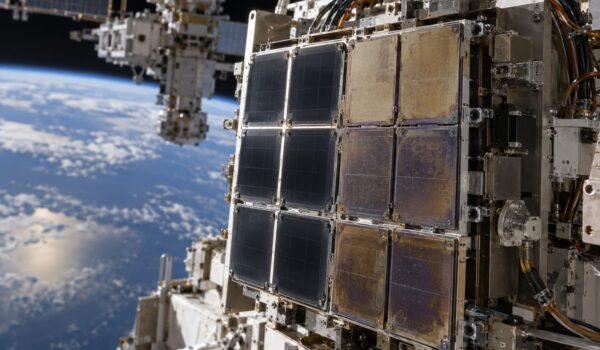
Particle detectors sent into space are designed to survive conditions that ordinary electronics never encounter. They operate in vacuum, experience repeated temperature changes and may remain active for many years without the possibility of returning to a laboratory for repair. One of their most persistent challenges is radiation. Ironically, the same high-energy particles that scientists want to measure can slowly change the sensors and electronics used to detect them.
This process is known as radiation damage or radiation ageing. It rarely means that an instrument suddenly stops working after receiving a certain dose. More often, its characteristics change gradually. Sensors can become noisier, electronic components may respond differently and measurements can require increasingly careful calibration. For a long-duration mission, the important question is therefore not only whether a detector can survive in space, but whether it can continue producing measurements that scientists understand well enough to trust.
When the signal also causes damage
Cosmic rays include protons, electrons and atomic nuclei travelling through space at high energies. When one of these particles passes through a scientific instrument, it interacts with detector materials and leaves measurable signals. Researchers use those signals to reconstruct properties such as the particle’s direction, charge and energy.
But the particle does not interact only with the part of the detector intended to measure it. It may also pass through semiconductor sensors, electronic circuits, cables, shielding and supporting structures. Some interactions deposit electrical charge, while others can disturb the microscopic arrangement of atoms inside a material.
A single particle usually produces only a tiny effect. The challenge appears when exposure continues for years. Millions or billions of interactions accumulate, and small changes that were initially irrelevant may eventually become measurable. The detector still functions, but it is no longer exactly the same detector that entered orbit.
This is why space experiments must be monitored continuously. Scientists cannot simply calibrate an instrument before launch and assume that its behaviour will remain identical throughout the mission.
What radiation does to silicon
Silicon is widely used in particle physics because it can measure the passage of charged particles with extremely high precision. A particle travelling through a silicon sensor creates electrical charge, which is collected and converted into a signal. Several layers of such sensors can be used to reconstruct the particle’s trajectory.
Radiation can gradually disturb the crystal structure of the silicon. Energetic particles may knock atoms away from their normal positions, leaving microscopic defects in the material. These defects can interfere with the movement and collection of electrical charge.
One common consequence is an increase in leakage current. Even without a useful particle signal, a small electrical current naturally flows through a semiconductor sensor. Radiation damage can make that current larger. As leakage current increases, electronic noise may also rise, making weak signals slightly more difficult to distinguish.
Radiation can also reduce the efficiency with which the sensor collects charge. A particle may still pass through the detector, but the signal it produces can gradually become weaker or less clean. Scientists must then adjust calibration procedures and analysis methods so that measurements made late in a mission remain comparable with those collected years earlier.
Temperature matters as well. The behaviour of irradiated silicon changes with temperature, which is one reason thermal control is important in precision experiments. Cooling can reduce leakage current and help preserve detector performance, but temperature itself must also be measured accurately because it influences calibration.
Electronics age too
The silicon sensor is only one part of a detector. Signals must be amplified, digitised, processed and transmitted by electronic systems. These components are also exposed to radiation.
One type of damage accumulates slowly as materials absorb ionising radiation. Over time, transistor characteristics may shift and circuits may require larger operating margins. Another type of problem can occur suddenly when a single energetic particle passes through an electronic component and temporarily changes its state. A bit in memory may flip, a processor may produce an incorrect value or a circuit may briefly behave unexpectedly.
Such single-event effects are not the same as gradual ageing, but both must be considered when designing equipment for space. Critical systems can include redundancy, error correction and automatic recovery procedures. If one measurement channel behaves abnormally, software may identify the problem and exclude that channel until its condition is understood.
Engineers also test components on Earth before launch by exposing them to controlled radiation. These experiments help estimate how particular electronics may behave after years in orbit. The difficulty is that the real radiation environment is complex, containing particles with many different energies and origins. Ground testing can reproduce important parts of that environment, but it can never reproduce every detail of a long mission perfectly.
How scientists notice that a detector is ageing
A detector cannot report simply that it has become 5% older. Researchers must infer changes from its behaviour.
They monitor quantities such as sensor currents, noise levels, temperatures, efficiencies and the response of individual channels. Known particle populations are particularly valuable. If the detector measures a type of particle whose behaviour is already well understood, scientists can compare current measurements with earlier ones and look for gradual changes.
Calibration therefore continues throughout the mission. Instead of treating ageing as an unexpected problem, researchers build time-dependent corrections into the analysis. A sensor layer that responds slightly differently after ten years can still produce useful data if its new behaviour is measured accurately.
This distinction is important. A detector does not need to remain physically unchanged to remain scientifically useful. What matters is whether its changes can be tracked and corrected.
Long missions can even improve understanding of the instrument. After years of operation, scientists have far more information about temperature dependence, individual sensor behaviour and long-term trends than they had shortly after launch. The hardware may have aged, while the mathematical model used to interpret it has become better.
Why long-term stability matters for physics
Radiation ageing becomes especially important when researchers compare measurements collected many years apart. Suppose scientists want to study how cosmic-ray intensity changes during different phases of solar activity. A difference seen between two periods could represent a real physical change, but it could also be caused partly by changing detector efficiency.
To separate the two, researchers must understand the instrument’s long-term behaviour. Even a small uncorrected drift can matter when the statistical precision of an experiment is extremely high.
The same issue appears when searching for rare particles. If a possible discovery depends on a very small number of unusual events, scientists must be confident that those events were not produced by a malfunctioning or degraded detector component. Independent detector layers, calibration data and long-term performance records become essential evidence.
Radiation damage therefore affects more than engineering. It directly influences how confidently a scientific result can be interpreted.
Can an old detector remain useful?
Yes. Many space instruments operate successfully far beyond their original planned lifetimes. Ageing does not automatically make their data unreliable. The key is continuous monitoring, careful calibration and a detailed understanding of how performance changes.
Some parts of a detector may deteriorate faster than others. Individual channels can be disabled, thresholds can be adjusted and software can compensate for known effects. Analysis methods may also improve, allowing scientists to recover useful information even as hardware performance slowly changes.
There is nevertheless a limit. Eventually, noise may become too large, too many channels may fail or another critical system may stop operating. Space experiments cannot escape material ageing forever. Their design therefore includes margins intended to preserve useful performance for as long as possible.
The remarkable part is how gradual this process can be. A detector exposed to radiation every day may continue operating for more than a decade while still producing precision science. It survives not because radiation leaves it untouched, but because engineers anticipated change and scientists continually measure that change.
Cosmic radiation is therefore both the subject of the experiment and one of the forces slowly transforming it. Every particle recorded contributes information about the universe, while the accumulated radiation environment gradually modifies the instrument itself. Long-duration space physics depends on understanding both processes at the same time: what the detector tells us about cosmic particles, and what those particles are doing to the detector that measures them.